
Difference between 200, 300, and 400 Series Stainless Steel: A Complete Guide
Date : Mar 28, 2025Stainless steel exists everywhere. It exists in everything: office buildings, power plants, surgical tools, and pots. But stainless steel remains not as a single entity. Really, it is many. It is a family of material groups in series. Some common characteristics define upon it.
The 200, 300, and 400 series grades that are used most commonly differ in price, in corrosion resistance, and in mechanical properties. The particular application is what determines a preferred grade.
Plain language will explain properties, applications, and differences within the series of all stainless steels.
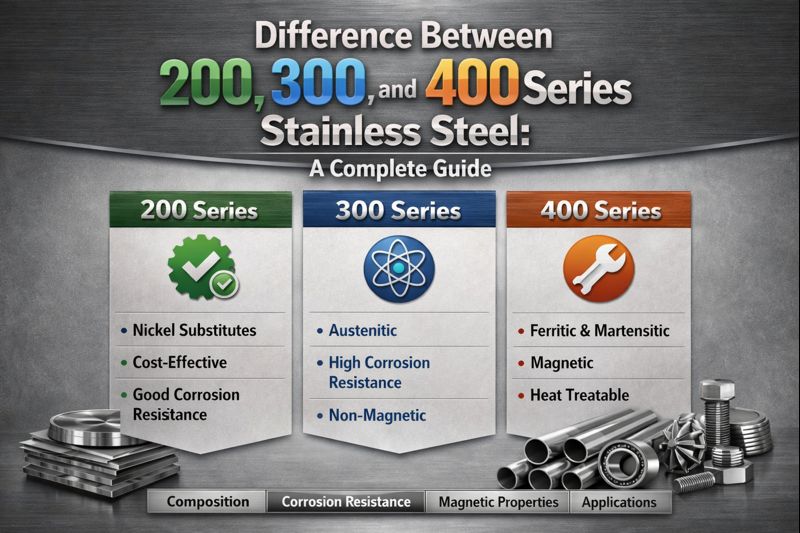
1. What Are Stainless Steel Series?
Stainless steel series means stainless alloys families defined through chemical composition.
Series numbers like 200, 300 or 400 show the relative percentages for chromium, nickel, manganese and carbon. They govern the material's strength, corrosion resistance and cost in that order.
2. Overview of Each Stainless-Steel Series
A. 200 Series Stainless Steel
200 series stainless steels are austenitic stainless steels developed originally as a low-nickel alternative for 300 series stainless steels.
Composition
- Chromium: 15, 18%
- Nickel:1, 4% (not high)
- Manganese: High (as a partial substitute of nickel)
Key Features
- Cost less than the 300 series
- Good strength
- Moderate corrosion resistance
- Non-magnetic in the annealed state
Common Uses
- Kitchen utensils
- Household appliances
- Budget furniture fittings
- Food service equipment
- The doors, windows, and railings are located inland, on the side opposite from the coast.
B. 300 Series Stainless Steel
Globally, stainless steels' most common family is the 300 series.
Composition
- Chromium: 17, 20%
- Nickel:8, 12%
- Molybdenum exists within some stainless steels that exist.
- 316 is an example.
Excellent corrosion resistance Key Features
- Excellent corrosion resistance
- Non-magnetic
- Highly durable
- Good weld ability and formability
Common Uses
- Kitchen equipment, sinks, cookware
- Chemical processing
- Marine applications (316 grade)
- Food processing machinery
- Pharmaceutics and medicine equip
C. 400 Series Stainless Steel
The 400 series of stainless steels are ferritin or martensitic in nature. These steels contain little nickel or no nickel within.
Composition
- Chromium:11, 18%
- Nickel:Very low or none
- Carbon:Higher than 300 series
Key Features
- Magnetic
- It resists corrosion from moderate to well
- Very strong and hard to the touch like especially martensitic grades 410 and 420
- The 200 and 300 series cost more now.
Common Uses
- Knife blades
- Automotive parts
- Turbine components
- Fasteners and tools
- Industrial equipment
- Cutlery (grades 410, 420)
3. Major Differences between 200, 300 & 400 Series Stainless Steel
1. Corrosion Resistance
- 300 Series: Excellent
- 400 Series:Moderate
- 200 series has less length overall. The 300 series has more length to it.
- 400 series is not quite as good as beyond.
2. Strength
- 400 Series: Highest of all types (especially martensitic grades)
- 300 Series: High and stable in quality
- 200 Series: Good, but slightly less stable under heat
3. Nickel Content
- 300 Series:High
- 200 Series:Low (nickel partially replaced with manganese)
- 400 Series:Almost none at all
4. Magnetism
- 300 Series:Non-magnetic
- 200 Series:Mostly non-magnetic in nature
- 400 Series:Magnetic
5. Applications
- 200 Series:Low-cost household and commercial uses for.
- 300 Series:Uses include heavy-duty industrial, medical, marine
- 400 Series:Tools, blades, automotive components for cars
4. Which Stainless Steel Series Should You Choose?
Choose 200 Series if:
- A less costly stainless steel is what you desire
- It fits indoor spaces or less corrosive environments.
- Appearance seems more important for long-term corrosion resistance
Choose 300 Series if:
- You need high corrosion resistance
- Applications include saltwater, chemicals, and food.
You want it to last long and endure.
Choose 400 Series if:
- A hard magnetic stainless steel material is what you need.
- You make tools, knives, fasteners, or industrial parts.
You want it to last long and endure.
Conclusion
When someone selects from the 200 series, 300 series or 400 series, that depends upon what the instrument applies to, what environment it is in, and what budget is available.
- 200 series:Economical. It is good for indoor environments.
- 300 series: Best corrosion resistance. Used in food processing, medical applications and for marine use.
- 400 series: Used in engineering tools, machinery, and equipment, including automotive components needing heat resistance.